Have you ever received a message that simply said ION and wondered what it meant? 🤔 You’re not alone. Modern texting is full of abbreviations, slang, and shortcuts that can completely change how people communicate online.
From social media platforms to everyday chats, these expressions help people type faster while keeping conversations casual and engaging.
If you’ve been searching for the ion meaning in text, you’ve come to the right place. This guide explains everything you need to know, from its most common definition to its history, different meanings, real-life examples, and the situations where people use it.
Whether you’re chatting with friends, scrolling through TikTok, reading Snapchat messages, or texting someone new, understanding ION will help you avoid confusion and communicate with confidence. 📱✨
What Does ION Mean in Text?
Quick Answer 📌
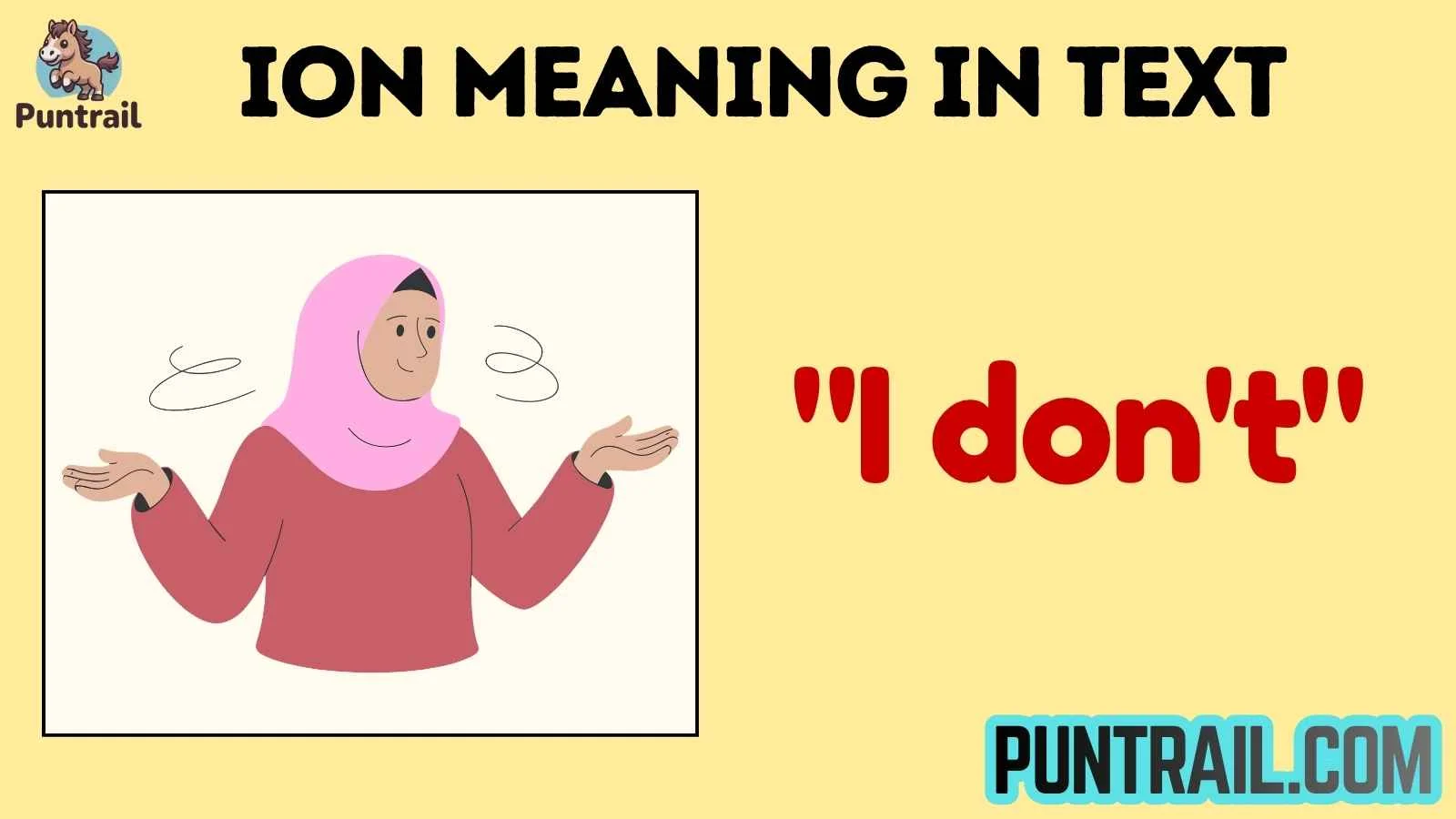
The ION meaning in text is “I don’t.” Instead of typing I don’t, many people shorten the phrase to ION in casual conversations.
For example:
- ION know what happened.
- ION think that’s true.
- ION want pizza tonight.
- ION remember telling you that.
- ION feel like going out today.
Although it looks like the scientific word ion, its meaning in texting is completely different. In internet slang, ION is simply a fast and informal way to write I don’t.
Because texting focuses on speed and convenience, users often remove apostrophes and spaces. Over time, I don’t naturally became ION in many online communities.
Why Do People Use ION Instead of “I Don’t”?
Text messaging has always encouraged shorter words. People want to send messages quickly, especially on smartphones. 📲
Instead of typing:
I don’t know.
Many users simply type:
ION know.
The message is shorter, faster, and still easy to understand when you know the slang.
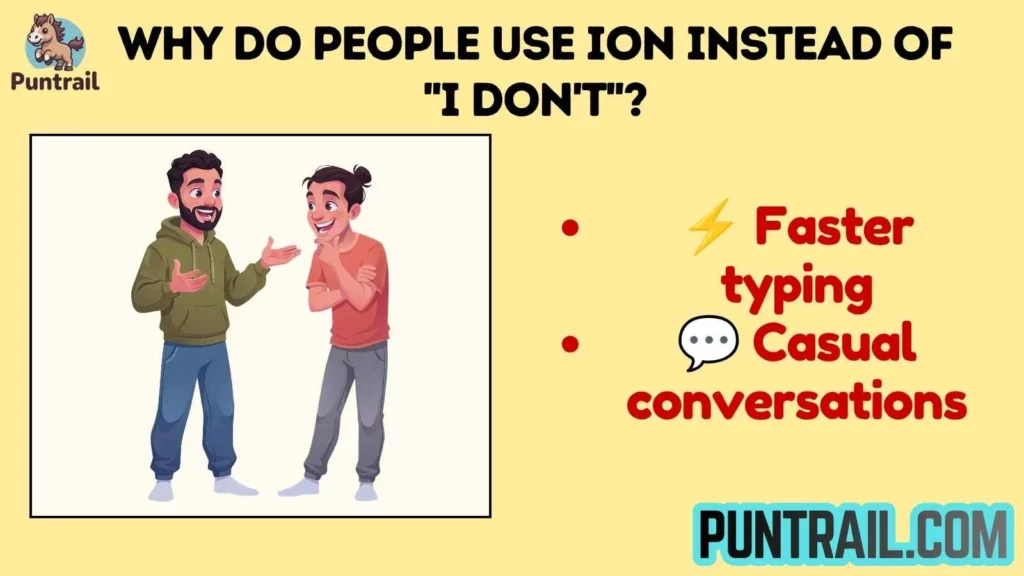
Some of the biggest reasons people use ION include:
- ⚡ Faster typing
- 💬 Casual conversations
- 📱 Mobile-friendly messaging
- 😄 Popular internet slang
- 🎯 Fits modern texting culture
This abbreviation has become especially common among younger users who communicate through short messages every day.
Comparison Table
| Standard English | Text Slang |
|---|---|
| I don’t know | ION know |
| I don’t care | ION care |
| I don’t think so | ION think so |
| I don’t remember | ION remember |
| I don’t want to | ION wanna |
As you can see, the meaning stays exactly the same. Only the spelling changes.
The Origin of ION in Texting
Like many internet abbreviations, ION didn’t appear overnight. It developed naturally as online communication became more informal.
Years ago, people mainly used complete sentences in emails and online forums. As texting apps and smartphones became more popular, shorter expressions started replacing longer phrases.
Here’s how the transformation likely happened:
I don’t
⬇
I dont
⬇
Ion’t
⬇
ION
Many people pronounce I don’t quickly during everyday conversations. When spoken aloud, it often sounds very close to ION, which helped the abbreviation spread naturally.
Eventually, social media users adopted it because it saved time while still sounding natural.
Today, you’ll find it across:
- 📱 Text messages
- 💬 Group chats
- 🎮 Gaming chats
- 📸 Snapchat
- 🎵 TikTok
- 🐦 X (formerly Twitter)
- 💻 Online communities
Its popularity continues to grow because informal writing has become the standard for many online conversations.
Different Meanings of ION in Text
Although I don’t is by far the most common definition, ION can have different meanings depending on the conversation.
Understanding the context is important because the same three letters may represent different ideas.
1. I Don’t (Most Common Meaning) ⭐
This is the meaning you’ll encounter most often.
Examples:
- ION think that’s right.
- ION like scary movies.
- ION have time today.
- ION understand this homework.
- ION agree with that opinion.
Whenever ION appears before a verb like know, want, care, think, or remember, it almost always means I don’t.
2. Scientific Meaning
Outside texting, an ion is a charged atom or molecule.
For example:
- Sodium ions carry a positive charge.
- Chloride ions carry a negative charge.
This scientific definition has nothing to do with texting slang.
If you’re reading a chemistry article, ion refers to science—not internet slang.
3. Brand or Product Name
Occasionally, Ion may refer to a company, product, software, or brand name.
Examples include:
- Ion Audio
- Ion Television
- Ion speakers
Again, the surrounding conversation tells you which meaning applies.
4. Username or Nickname
Some people also use ION as:
- a gaming username
- a nickname
- an online handle
- part of a creator’s name
In these situations, it isn’t an abbreviation at all.
How to Identify the Correct Meaning
| Situation | Meaning |
|---|---|
| ION know | I don’t |
| ION think so | I don’t |
| Chemistry class | Charged particle |
| Electronics discussion | Brand name |
| Username | Personal nickname |
Looking at the rest of the sentence is usually enough to determine the intended meaning.
How ION Is Used in Everyday Conversations
One reason the ion meaning in text has become so popular is that it sounds natural in casual speech. People use it in conversations with friends, classmates, siblings, and online communities where informal language is common.
Here are some realistic examples.
Example 1
Alex: Are you coming tonight?
Jordan: ION think I can.
Example 2
Emma: Did you watch the game?
Ryan: ION even know it started.
Example 3
Sarah: Want to order pizza?
Mia: ION feel hungry.
Example 4
Chris: Did you finish your assignment?
Taylor: ION have enough time yet.
Example 5
Friend: Why didn’t you answer?
You: ION see your message until now.
Each conversation sounds relaxed and conversational, which explains why many people prefer using ION instead of typing the full phrase.
Everyday Situations Where You Might See ION
People commonly use this slang in:
- 📱 Text messages with friends
- 💬 Group chats
- 🎮 Online gaming
- 🎵 TikTok comments
- 📸 Snapchat conversations
- 📷 Instagram DMs
- 😂 Meme captions
- 👨🎓 School chats
- 💼 Casual workplace messages among close coworkers
In professional emails or formal communication, it’s better to write I don’t instead of ION to maintain a polished tone.
ION Meaning on Snapchat 👻
Snapchat is one of the biggest reasons internet slang spreads so quickly. Since messages are usually short and casual, users often replace longer phrases with abbreviations. That’s why you’ll frequently see ION in private chats, streak messages, and group conversations.
On Snapchat, the ION meaning in text is almost always “I don’t.”
Snapchat Examples
Friend: Are you free tonight?
You: ION know yet.
Friend: Did you save the picture?
You: ION think I did.
Friend: Want to start a streak?
You: ION use Snapchat that much anymore.
These examples show that ION naturally replaces I don’t without changing the meaning of the sentence.
Why Snapchat Users Like ION
People prefer using ION because it is:
- 👻 Fast to type
- 📱 Easy on mobile keyboards
- 💬 Casual and friendly
- ⚡ Perfect for quick replies
- 😄 Common among younger users
Since Snapchat conversations disappear quickly, users tend to type as naturally as they speak, making abbreviations like ION very popular.
ION Meaning on TikTok 🎵
TikTok comments move incredibly fast. Creators and viewers often use short slang expressions to react to videos without typing full sentences.
On TikTok, the ion meaning in text still means I don’t in most situations.
Common TikTok Comments
- ION think that’s real 😂
- ION blame you.
- ION understand how this happened.
- ION even know what I watched.
- ION care what anyone says.
You’ll also notice creators using ION in captions because it sounds conversational and matches how people actually speak.
Why It Became Popular on TikTok
Several factors helped the slang gain popularity:
- Short-form content encourages shorter comments.
- Viral trends spread new slang quickly.
- Younger audiences adopt abbreviations faster.
- Casual conversations dominate the platform.
As trends evolve, ION continues to appear in millions of comments every day.
ION Meaning on Instagram 📸
Instagram users often communicate through comments, Stories, Notes, and direct messages. Because these interactions are usually informal, abbreviations fit naturally into conversations.
Examples include:
- ION think that’s your best picture.
- ION remember this trip.
- ION know where this café is.
- ION usually wake up this early.
- ION wanna miss this concert.
Many influencers also use internet slang to sound more relatable to their followers.
Instagram Situations Where You May See ION
- Story replies
- Reel comments
- Group chats
- Direct Messages (DMs)
- Notes feature
- Meme pages
Although the wording is casual, the meaning remains exactly the same.
ION Meaning on Facebook and Messenger 💬
Facebook has users of all ages, but younger users often bring texting slang into Messenger conversations.
Examples include:
Friend: Are you joining us later?
You: ION think I can.
Friend: Did you hear the news?
You: ION know anything yet.
Friend: You watched the whole series?
You: ION even finish episode one.
Because Messenger feels more like texting than email, abbreviations such as ION appear frequently.
Real-Life Examples of ION in Different Situations
Learning through examples makes internet slang much easier to understand. Here are several everyday situations where the ion meaning in text fits naturally.
🎓 Talking About School
- ION understand today’s math lesson.
- ION finish my homework.
- ION remember the test date.
- ION have my notebook.
- ION study enough yesterday.
💼 Talking About Work
- ION have time today.
- ION think the meeting is finished.
- ION receive the email yet.
- ION know who’s leading the project.
- ION work on weekends.
😊Talking About Friends
- ION know him very well.
- ION think she’s upset.
- ION forget birthdays.
- ION usually stay out late.
- ION mind helping you.
🍕Talking About Food
- ION like mushrooms.
- ION want dessert.
- ION cook very often.
- ION eat spicy food.
- ION order takeout every weekend.
🎬Talking About Movies
- ION watch horror films.
- ION remember that actor.
- ION think the ending was good.
- ION finish the series.
- ION understand the plot.
These examples demonstrate how flexible the abbreviation is across different conversations.
When Should You Use ION?
Although ION is widely accepted in casual messaging, it isn’t suitable everywhere. Understanding when to use it helps you communicate effectively.
Great Situations to Use ION ✅
You can comfortably use ION in:
- 📱 Text messages
- 👥 Friend group chats
- 🎮 Gaming conversations
- 📸 Snapchat
- 🎵 TikTok comments
- 📷 Instagram DMs
- 😂 Meme pages
- 💬 Casual online discussions
In these situations, people expect relaxed language.
Situations Where You Should Avoid ION ❌
Avoid using ION in:
- Professional emails
- Business reports
- Job applications
- School essays
- Academic writing
- Legal documents
- Customer support emails
- Official announcements
Instead, write the complete phrase:
I don’t
This sounds more professional and avoids confusion.
Common Mistakes People Make About ION
Although ION looks simple, many people misunderstand it at first.
Here are some of the most common mistakes.
Mistake 1: Thinking It Always Refers to Science
Many people immediately think of chemistry.
Example:
Sodium ion
This scientific term has nothing to do with texting slang.
Mistake 2: Reading It as One Word
Some beginners read ION like a regular English word.
Instead, mentally replace it with:
I don’t
The sentence instantly makes sense.
Mistake 3: Using It in Formal Writing
Writing this in an email:
ION understand the report.
looks unprofessional.
Instead write:
I don’t understand the report.
Mistake 4: Assuming Everyone Knows It
Older users or people unfamiliar with internet slang may not recognize the abbreviation.
If you’re unsure whether someone understands it, writing the full phrase is usually the better choice.
ION vs Other Popular Text Slang
Many texting abbreviations look similar but have completely different meanings. Here’s an easy comparison.
| Slang | Meaning | Example |
|---|---|---|
| ION | I don’t | ION know |
| IDK | I don’t know | IDK what’s happening |
| IMO | In my opinion | IMO that’s better |
| TBH | To be honest | TBH I liked it |
| SMH | Shaking my head | SMH that’s confused |
| FR | For real | FR that’s funny |
| NGL | Not gonna lie | NGL I expected more |
| BRB | Be right back | BRB grabbing lunch |
| BTW | By the way | BTW thanks again |
| LMK | Let me know | LMK tomorrow |
Understanding these abbreviations helps you read online conversations much faster.
Why Internet Slang Like ION Keeps Growing 🌎
Internet language changes every year. New abbreviations appear while older ones fade away. The ion meaning in text has remained popular because it reflects how people naturally speak in everyday conversations.
Several factors contribute to its continued use:
- Smartphones encourage shorter typing.
- Social media rewards quick communication.
- Younger generations create new slang regularly.
- Online communities spread trends worldwide.
- Informal messaging has become part of daily life.
As digital communication continues to evolve, abbreviations like ION help people express themselves quickly without losing the intended meaning.
Advanced Tips for Understanding ION in Text 💡
Once you know that the ION meaning in text usually stands for “I don’t,” the next step is learning how to recognize it naturally in conversations. Since internet slang changes quickly, understanding context is just as important as knowing the definition.
Here are a few expert tips to help you interpret ION correctly every time.
Look at the Words That Follow
Most of the time, ION appears before a verb.
Examples include:
- ION know.
- ION think so.
- ION remember.
- ION want that.
- ION believe it.
- ION care anymore.
- ION need help.
- ION like that movie.
If the sentence still makes sense when you replace ION with I don’t, you’ve found the correct meaning.
Consider the Conversation
Always read the entire message instead of focusing on one word.
For example:
Message: ION think she’s coming.
Here, replacing ION with I don’t makes perfect sense.
However, if you’re reading a chemistry textbook discussing atoms and molecules, the word ion clearly refers to science instead of texting slang.
Context is the easiest way to determine the correct meaning.
Understand the Tone
Using ION creates a relaxed and conversational tone. It sounds friendly, informal, and similar to everyday speech.
Compare these examples:
Formal
I don’t believe that information is accurate.
Casual
ION believe that.
Both sentences express the same idea, but the second feels much more like a text message between friends.
Regional and Cultural Differences 🌍
Internet slang often spreads across countries, but not every abbreviation is equally popular everywhere.
The ion meaning in text is especially common among younger English-speaking users who spend time on social media platforms. It has become part of online culture through texting, memes, viral videos, and everyday digital conversations.
Depending on the community, some people may use ION frequently, while others may prefer writing I don’t in full. This difference is completely normal because online language evolves at different speeds across regions and age groups.
You may notice that:
- Teenagers and young adults use it more often than older generations.
- Social media users are generally more familiar with it than people who mainly use email.
- Gamers and online communities often adopt new slang earlier than the general public.
Even if someone has never seen ION before, the surrounding sentence usually makes its meaning easy to understand.
Is ION Grammatically Correct? ✍️
This is one of the most common questions people ask after learning the ion meaning in text.
The answer is simple:
No. ION is not grammatically correct in formal English. It is an internet abbreviation used only in informal communication.
Appropriate Uses
You can use ION in:
- Personal text messages
- Casual chats
- Social media comments
- Gaming conversations
- Friendly group messages
Inappropriate Uses
Avoid using it in:
- School assignments
- Business emails
- Job applications
- Professional reports
- Official documents
- Academic writing
In those situations, always write the complete phrase:
I don’t
Using standard English helps maintain clarity and professionalism.
Quick Summary Table
The table below summarizes everything you need to remember about the ion meaning in text.
| Topic | Explanation |
|---|---|
| Primary meaning | I don’t |
| Type | Internet slang |
| Used in | Texting, social media, chats |
| Formal writing | ❌ No |
| Casual messaging | ✅ Yes |
| Common platforms | Snapchat, TikTok, Instagram, Messenger, gaming chats |
| Scientific meaning | Charged atom or molecule |
| Best way to identify meaning | Read the surrounding context |
This quick reference is useful whenever you encounter ION in a conversation.
Key Takeaways About ION Meaning in Text 📌
If you only remember a few things from this guide, make them these:
- ✅ ION usually means I don’t.
- ✅ It is mainly used in casual text conversations.
- ✅ Social media helped make the abbreviation popular.
- ✅ Context tells you whether it means texting slang or the scientific term.
- ✅ It should not be used in formal or professional writing.
- ✅ It saves time while typing and sounds natural in everyday conversations.
- ✅ Most younger internet users immediately recognize its meaning.
Once you understand these points, reading online messages becomes much easier.
FAQs:
What does ION mean in text?
The ion meaning in text is “I don’t.” It is an informal abbreviation commonly used in text messages, social media posts, and online chats to make typing faster.
Does ION always mean I don’t?
No. While I don’t is the most common meaning in texting, ion can also refer to a charged atom in chemistry or be part of a brand name or username. Always use the surrounding context to determine the correct meaning.
Is ION considered slang?
Yes. ION is internet slang. It is designed for casual communication and is widely used on platforms like Snapchat, TikTok, Instagram, and messaging apps.
Can I use ION in professional emails?
No. Professional communication should use standard English. Instead of writing ION understand the report, write I don’t understand the report to maintain a polished and professional tone.
Why do people type ION instead of I don’t?
People use ION because it is quicker to type, reflects natural speech, and fits the fast-paced style of online conversations. It has become a popular shortcut among social media users and frequent texters.
Final Thoughts:
Understanding the ion meaning in text is easier once you know the context in which it is used. In most online conversations, ION simply means “I don’t,” making it a convenient shortcut for quick and informal communication.
Whether you’re reading messages on Snapchat, browsing TikTok comments, chatting on Instagram, or texting friends, recognizing this abbreviation helps you follow conversations with confidence.
At the same time, remember that context matters. The same word can represent a scientific ion in educational discussions or serve as part of a brand or username in other situations.
By paying attention to the surrounding words, you’ll quickly identify the intended meaning. As internet language continues to evolve, staying familiar with common slang like ION makes digital communication easier, more enjoyable, and far less confusing.

I’m the writer behind PunTrail, where I simplify internet slang, text abbreviations, and modern word meanings into easy-to-understand content. I focus on creating clear, human-friendly explanations that help readers quickly understand trending terms used in chats, social media, and everyday conversations.