Have you ever received a message that simply said “DW” and paused for a moment, wondering what it meant? You’re not alone.
Text messaging is filled with abbreviations, acronyms, and internet slang that make conversations faster and more casual.
While many people instantly recognize terms like LOL or BRB, DW can still confuse those who don’t use it often.
If you’ve been searching for what does DW mean in text, you’re in the right place. The good news is that the meaning is simple, friendly, and widely used across texting apps, social media platforms, online games, and messaging services.
In most conversations, DW means “Don’t Worry.” It is a quick way to reassure someone, reduce stress, or let them know everything is okay. I
nstead of typing the full phrase, people simply write DW to save time while keeping the conversation natural.
However, like many internet abbreviations, DW can have different meanings depending on the context.
nderstanding those meanings will help you avoid confusion and communicate more confidently online.
In this guide, you’ll learn the most common meaning of DW, where it came from, how people use it, when you should avoid it, and plenty of real-life examples that make everything easy to understand.
What Does DW Mean in Text? 📱
The most common answer to what does DW mean in text is:
DW = Don’t Worry
People use it to reassure someone that everything is fine or that there is no need to stress about a situation.
Quick Definition
| Abbreviation | Meaning | Common Use |
|---|---|---|
| DW | Don’t Worry | Reassurance in conversations |
It usually appears in casual conversations between:
- 😊 Friends
- ❤️ Family members
- 💬 Classmates
- 🎮 Gamers
- 👩💻 Coworkers (informally)
- 📱 Social media users
Instead of writing:
Don’t worry about it.
People simply type:
DW!
The shorter version saves time and feels more conversational.
Featured Snippet Answer ⭐
DW means “Don’t Worry” in text messages. It is commonly used to reassure someone that everything is okay or that they should not feel stressed, guilty, or concerned.
Origin of DW in Texting 🌍
Like many texting abbreviations, DW became popular as mobile phones evolved.
Years ago, people had limited characters in text messages. Typing long sentences took more effort, especially on older mobile keyboards. As a result, users started shortening common phrases into easy-to-type acronyms.
Examples include:
- LOL = Laugh Out Loud
- BRB = Be Right Back
- BTW = By The Way
- IMO = In My Opinion
- DW = Don’t Worry
As smartphones, instant messaging apps, and social media platforms became more popular, DW spread quickly around the world.
Today, it is commonly seen on:
- 📱 SMS
- 👻 Snapchat
- 🎵 TikTok
- 💙 Facebook Messenger
- 💻 Discord
- 🎮 Online gaming chats
Because it expresses reassurance in only two letters, it remains one of the simplest and most useful abbreviations in digital communication.
How Is DW Used in Everyday Conversations? 💬
The beauty of DW is its flexibility. It fits naturally into many different conversations.
Here are the most common situations where people use it.
Reassuring Someone ❤️
Someone feels nervous or guilty.
Example:
Emma: I’m sorry I replied late.
Jake: DW! I know you’ve been busy.
Comforting a Friend 😊
Someone worries about a mistake.
Example:
Friend:
I accidentally deleted the file.
You:
DW. We have a backup.
Reducing Stress 😌
People often use DW to calm someone’s anxiety.
Example:
“I’m running five minutes late.”
“DW. I’m still getting ready.”
Offering Help 🤝
Sometimes DW means:
Leave it to me.
Example:
“I’ll clean everything.”
“DW, I’ll help.”
Responding to an Apology 💙
Instead of saying:
“It’s okay.”
People may reply:
“DW 😊”
This sounds warm, casual, and forgiving.
During Online Gaming 🎮
Gamers often encourage teammates using DW.
Example:
Player 1:
Sorry, I missed that shot.
Player 2:
DW. We’ll win the next round.
The message helps keep the team positive.
Examples of DW in Text Messages ✉️
Below are real-life examples showing how DW fits naturally into conversations.
| Situation | Conversation |
|---|---|
| Late reply | DW, I completely understand. |
| Forgot homework | DW, the teacher extended the deadline. |
| Running late | DW, I’m still on my way too. |
| Feeling nervous | DW, you’ll do great! |
| Accidentally broke something | DW, accidents happen. |
| Missed a meeting | DW, I’ll fill you in later. |
| Lost an item | DW, we’ll find it together. |
| Forgot to call | DW, I wasn’t expecting it anyway. |
Notice how every example communicates reassurance instead of criticism.
Other Meanings of DW 🔍
Although what does DW mean in text usually refers to “Don’t Worry,” the abbreviation can have several other meanings depending on the conversation, platform, or industry. That’s why context is everything when interpreting internet slang.
Here’s a quick overview of the most common meanings.
| DW Meaning | Where It’s Used | Common? |
|---|---|---|
| Don’t Worry | Text messages, social media, chats | ⭐⭐⭐⭐⭐ |
| Dear Wife | Family conversations, forums | ⭐⭐⭐ |
| Driving While | Online discussions | ⭐⭐ |
| Data Warehouse | Business and technology | ⭐⭐ |
| Dead Weight | Sports or casual slang | ⭐ |
| Doctor Who | Fan communities | ⭐⭐ |
For everyday texting, you can safely assume that DW means “Don’t Worry” unless the conversation clearly suggests another meaning.
DW as “Dear Wife” ❤️
Some people use DW to mean Dear Wife, especially in parenting groups, family blogs, and relationship forums.
Example:
- My DW surprised me with concert tickets.
- My DW loves traveling during summer.
In these conversations, DW doesn’t mean “Don’t Worry.” Instead, it refers to someone’s spouse.
DW as “Driving While” 🚗
In some online discussions, DW may stand for Driving While.
Examples:
- DW distracted is dangerous.
- Avoid DW tired after a long shift.
This usage is far less common than Don’t Worry and usually appears in discussions about road safety.
DW as “Data Warehouse” 💻
In technology and business, DW often means Data Warehouse.
For example:
- The company migrated its DW to the cloud.
- Our analytics depend on the DW system.
If you’re chatting with IT professionals or reading technical documents, this is likely the intended meaning.
DW as “Doctor Who” 📺
Fans of the popular science-fiction television series sometimes shorten Doctor Who to DW.
Example:
- I’m watching DW this weekend.
- DW has one of the best fan communities.
Again, context makes the meaning obvious.
What Does DW Mean on Snapchat? 👻
On Snapchat, DW almost always means “Don’t Worry.”
Because Snapchat conversations are quick and informal, users often rely on abbreviations to keep messages short.
Example Conversation
Alex:
Sorry I opened your Snap late.
Jordan:
DW 😊
Here, DW tells the other person that everything is fine.
Common Snapchat Situations
People use DW when someone:
- 😅 Apologizes for replying late
- 📸 Misses a Snap
- ⏰ Arrives late
- ❤️ Feels embarrassed
- 🙏 Says sorry
Because Snapchat encourages casual communication, DW fits naturally into everyday chats.
Snapchat Example Messages
- DW, it happens.
- DW, I wasn’t busy.
- DW, send it later.
- DW, no problem.
- DW, take your time.
What Does DW Mean on Instagram? 📸
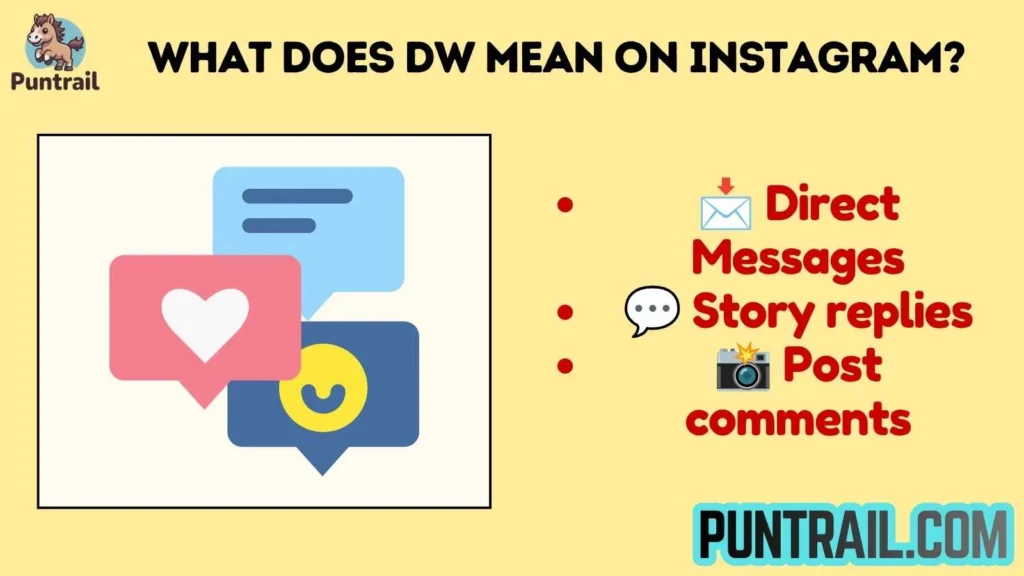
Instagram users also use DW as shorthand for Don’t Worry in direct messages and comment replies.
You’ll often see it when friends reassure each other after small mistakes or misunderstandings.
Example
Friend:
Sorry I forgot to tag you.
Reply:
DW! ❤️
Another example:
Friend:
I accidentally liked your old photo.
Reply:
DW 😂
These short responses keep conversations relaxed and friendly.
Where You’ll See DW on Instagram
- 📩 Direct Messages
- 💬 Story replies
- 📸 Post comments
- 🎥 Reels discussions
- ❤️ Group chats
On Instagram, DW almost never has a different meaning unless you’re in a niche community discussing technology or another specialized topic.
What Does DW Mean on TikTok? 🎵
TikTok comments move quickly, so users frequently shorten words and phrases.
Here, DW also means Don’t Worry.
Creators and viewers often use it to reassure others in the comments.
Examples
Comment:
I can’t find Part 2.
Reply:
DW, it’s pinned.
Another example:
Comment:
Sorry if this question sounds silly.
Reply:
DW! Ask anything.
TikTok users appreciate short, supportive replies, making DW one of the platform’s most common abbreviations.
Why TikTok Users Like DW
- ⚡ Fast to type
- 😊 Friendly
- 💬 Easy to understand
- ❤️ Positive tone
- 📱 Perfect for quick conversations
When Should You Avoid Using DW? 🚫
Even though DW is widely accepted, it isn’t appropriate for every conversation.
Knowing when not to use DW helps you communicate more professionally and respectfully.
Formal Emails
Avoid:
DW, I’ll send the report.
Better:
Don’t worry. I’ll send the report shortly.
Professional communication usually benefits from complete sentences.
Business Meetings
If you’re chatting with a client or manager, write the full phrase instead of using abbreviations.
Example:
Instead of:
DW.
Write:
Please don’t worry. Everything is under control.
Serious Situations
Avoid using DW when someone is discussing:
- Major illnesses
- Family emergencies
- Financial hardships
- Legal matters
- Emotional crises
A simple abbreviation may sound dismissive.
Instead, write something more thoughtful, such as:
- I’m here for you.
- Please don’t worry. We’ll work through this together.
- Let me know how I can help.
Talking to Someone Unfamiliar
If you don’t know whether the other person understands texting abbreviations, it’s safer to write the complete phrase.
This reduces confusion and keeps your message clear.
Tone and Etiquette When Using DW 😊
Although DW is only two letters, it can change the tone of a conversation.
Used correctly, it feels warm and supportive.
Used carelessly, it may seem too casual.
Best Situations
Friendly chats
Family conversations
Online gaming
Social media
Group messages
Situations to Avoid
Job interviews
Formal business emails
Academic papers
Official announcements
Serious personal discussions
Add Emojis for Friendliness
Many people combine DW with emojis.
Examples:
- DW 😊
- DW ❤️
- DW 👍
- DW 😄
- DW✨
These emojis make the reassurance feel even more genuine.
Common Mistakes People Make with DW ⚠️
Even experienced texters occasionally misuse abbreviations.
Here are some common mistakes to avoid.
Assuming Everyone Knows It
Not everyone understands internet slang.
If you’re texting someone older or less familiar with abbreviations, writing Don’t Worry can be clearer.
Using It Too Often
Repeating DW in every conversation may make your responses feel repetitive.
Mix it up with phrases like:
- It’s okay.
- No problem.
- You’re fine.
- Don’t stress.
- Everything’s good.
Using It in Formal Writing
Never write:
DW about your application.
Instead:
Please don’t worry about your application. We’ll contact you soon.
Professional writing should always prioritize clarity.
Misreading the Context
Sometimes people immediately assume DW means Don’t Worry, even when the discussion is about technology, relationships, or television.
Always consider the surrounding conversation before deciding what the abbreviation means.
DW vs Similar Texting Abbreviations 📱
Many texting abbreviations express reassurance, agreement, or friendliness. Knowing the differences helps you choose the right one.
| Abbreviation | Meaning | Typical Use |
|---|---|---|
| DW | Don’t Worry | Reassuring someone |
| NP | No Problem | Responding to thanks or apologies |
| NBD | No Big Deal | Downplaying a small issue |
| IDC | I Don’t Care | Expressing indifference (can sound rude) |
| TBH | To Be Honest | Introducing an honest opinion |
| IMO | In My Opinion | Sharing a personal viewpoint |
| BRB | Be Right Back | Stepping away briefly |
| TTYL | Talk To You Later | Ending a conversation politely |
DW vs NP
DW focuses on calming someone’s worries.
Example:
Sorry I’m late.
DW!
NP focuses on accepting an apology or favor.
Example:
Thanks for helping.
NP!
DW vs NBD
Both reduce concern, but they have slightly different tones.
DW reassures the other person directly.
NBD suggests that the situation itself isn’t important.
Example:
Sorry I spilled some water.
DW.
or
NBD.
Both work, but DW feels a little warmer and more personal.
DW vs IDC
These abbreviations should never be confused.
- DW = Friendly reassurance.
- IDC = I Don’t Care.
Compare the tone:
✅ DW, everything’s okay.
❌ IDC.
One comforts the other person, while the other may sound dismissive or rude.
Understanding these subtle differences will help you communicate more effectively and avoid misunderstandings in text conversations.
How to Reply When Someone Says DW 💬
When someone sends DW in a conversation, they’re usually trying to reassure you. A simple, friendly response keeps the conversation flowing naturally.
Here are some common replies:
- 😊 Thanks!
- ❤️ I appreciate it.
- 😄 That’s good to hear.
- 🙌 You’re the best!
- 👍 Okay, thanks for letting me know.
- 😅 I was worried for a second.
- 🤝 Thanks for understanding.
- 💙 That makes me feel better.
Example Conversations
Friend:
DW, I already finished the assignment.
You:
Awesome, thanks!
Coworker:
DW, I’ll handle the presentation.
You:
Perfect. Thanks for helping.
Sibling:
DW, Mom already knows.
You:
Haha, that’s a relief!
Responding positively shows that you understand the reassurance and appreciate the other person’s kindness.
DW Meanings Across Different Platforms 🌐
Although what does DW mean in text has the same primary meaning on most platforms, the way people use it can vary slightly depending on where they’re chatting.
| Platform | Most Common Meaning | Typical Situation |
|---|---|---|
| 📱 SMS | Don’t Worry | Everyday texting |
| Don’t Worry | Friends and family chats | |
| 👻 Snapchat | Don’t Worry | Quick replies and streak conversations |
| Don’t Worry | DMs, comments, and Story replies | |
| 🎵 TikTok | Don’t Worry | Comment sections and direct messages |
| 💻 Discord | Don’t Worry | Gaming and community chats |
| 🎮 Gaming Chats | Don’t Worry | Encouraging teammates |
| 💙 Facebook Messenger | Don’t Worry | Casual conversations |
No matter the platform, DW almost always carries a positive and reassuring tone.
FAQs:
Does DW always mean “Don’t Worry”?
No. While Don’t Worry is by far the most common meaning in texting and social media, DW can also stand for Dear Wife, Driving While, Data Warehouse, or Doctor Who. The intended meaning depends on the context of the conversation.
Is DW considered rude?
Not at all. In most casual conversations, DW is friendly, polite, and supportive. However, using it in formal emails or serious discussions may come across as too casual. In those situations, writing “Don’t worry” in full is a better choice.
Can I use DW in professional communication?
It’s best to avoid it in formal business emails, reports, client messages, or official documents. While colleagues who know each other well may occasionally use DW in internal chats, complete phrases create a more professional impression.
Why do people use DW instead of “Don’t Worry”?
People use DW because it’s:
- ⚡ Faster to type
- 📱 Convenient on mobile devices
- 💬 Common in online conversations
- 😊 Friendly and informal
- ⏳ A time-saving abbreviation
Like many texting shortcuts, it helps keep conversations quick and natural.
Is DW popular among younger users?
Yes. Teenagers and young adults frequently use DW on messaging apps and social media. However, it’s also widely understood by adults who regularly text, use group chats, or participate in online communities.
Final Thoughts:
If you’ve ever wondered what does DW mean in text, the answer is usually straightforward: DW stands for “Don’t Worry.”
It’s one of the most common texting abbreviations used to reassure someone, ease concerns, or respond kindly to an apology or mistake.
Whether you’re chatting through SMS, WhatsApp, Snapchat, Instagram, TikTok, Discord, or another messaging platform, you’ll most often see DW used as a quick, positive way to say that everything is okay.
While the abbreviation can have other meanings such as Dear Wife, Data Warehouse, or Doctor Who the surrounding conversation almost always makes the intended meaning clear.
The next time someone sends you DW, you’ll know they’re simply telling you to relax, not stress, and keep the conversation moving with confidence.

I’m the writer behind PunTrail, where I simplify internet slang, text abbreviations, and modern word meanings into easy-to-understand content. I focus on creating clear, human-friendly explanations that help readers quickly understand trending terms used in chats, social media, and everyday conversations.