Have you ever received a message that simply says “HY” and wondered what it actually means? 🤔 You’re not alone.
Every year, new texting abbreviations become popular across social media and messaging apps. Some are easy to understand, while others leave people confused.
If you’re searching what does HY mean in text, you’ve come to the right place. Whether you spotted it on Snapchat, TikTok, Instagram, WhatsApp, Discord, or in a regular text message, understanding the meaning depends on the conversation and the person using it.
The good news is that HY is usually simple, friendly, and easy to interpret. In most situations, it isn’t negative or offensive. Instead, it’s often used as a quick greeting or a casual way to agree with someone.
In this complete guide, you’ll learn every common meaning of HY, when to use it, when not to use it, real-life examples, common mistakes, and how it compares with other popular texting abbreviations. By the end, you’ll know exactly what someone means when they send HY. 😊
What Does HY Mean in Text?
The most common meaning of HY in text is simply “Hi” or “Hey.” 👋
People often type HY instead of writing the full greeting because it’s quick, casual, and convenient. Since texting is all about speed, many users shorten common words without worrying about perfect spelling.
Featured Snippet Answer
HY usually means “Hi” or “Hey” in text messages. It is a casual greeting people use to start a conversation on messaging apps and social media. Depending on the context, HY can also express agreement or represent other meanings, but greeting someone is its most common use.
Quick Meaning Table
| Text | Meaning | Usage |
|---|---|---|
| HY | Hi | Greeting someone |
| HY | Hey | Starting a conversation |
| HY | Yes (rare) | Showing agreement |
| HY | Context-specific abbreviation | Depends on the conversation |
Most of the time, you can safely read HY as a simple hello.
Example Conversations
Example 1
Friend: HY 👋
You: Hey! What’s up?
Example 2
Alex: HY! Long time no see.
Jordan: Nice to hear from you!
Example 3
Taylor: HY 😊
Morgan: Hi! How’s your day going?
These examples show that HY usually works exactly like saying Hi or Hey.
Why Do People Use HY Instead of Hi?
Text messaging has changed the way people communicate. Instead of typing full words, users often prefer shorter versions that save time.
Although “Hi” already has only two letters, many people accidentally or intentionally type HY because it feels natural on a keyboard or simply becomes a personal texting habit.
Here are some reasons why people use it.
🚀 It’s Faster
When you’re chatting quickly, tiny spelling changes happen naturally.
Instead of thinking about perfect spelling, people simply type what comes naturally.
📱 It Feels Casual
Online conversations are much more relaxed than formal writing.
Friends rarely worry about grammar while chatting.
Instead of saying:
“Hello.”
They might simply write:
“HY!”
The message feels friendly and informal.
😊 It’s Common Among Younger Users
Many teenagers and young adults create their own texting styles.
Some spell words differently just because they like how they look.
Examples include:
- Hy
- Hii
- Heyyy
- Heya
- Yo
- Sup
All of these serve the same purpose—they start a conversation.
💬 It Matches Internet Culture
Social media encourages fast communication.
Platforms like TikTok, Snapchat, Instagram, and Discord are filled with creative spellings and abbreviations.
Because of this, HY has become one of many casual greetings people recognize instantly.
The Origin of HY in Texting
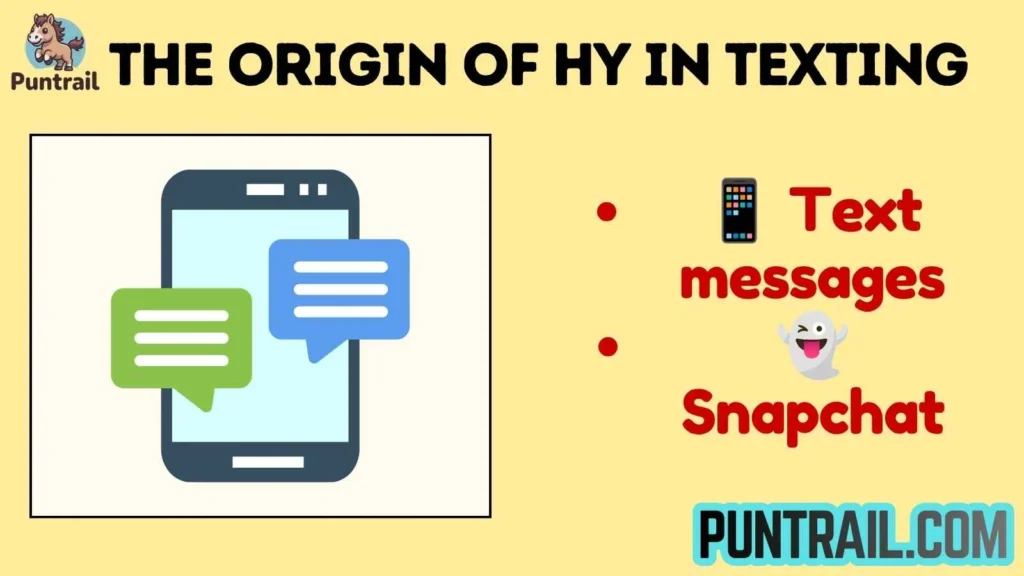
Unlike many internet abbreviations, HY doesn’t have one official creator or a documented starting point.
Instead, it developed naturally as texting became more popular.
In the early days of SMS messaging, users had limited characters. People looked for faster ways to communicate.
Over time, internet culture encouraged shortened spellings and creative typing styles.
That’s how variations like these became common:
- Hy
- Hey
- Hii
- Heya
- Yo
- Sup
- Ello
Rather than following strict grammar rules, people focused on making conversations feel quick and natural.
Today, HY appears across many digital platforms, including:
- 📱 Text messages
- 👻 Snapchat
- 🎵 TikTok
- 💬 Facebook Messenger
- 🎮 Discord
- 💼 Workplace chats (occasionally)
Its popularity continues because it feels simple, friendly, and effortless.
Different Meanings of HY Depending on Context
Although “Hi” is the meaning you’ll see most often, context always matters. A single abbreviation can have multiple interpretations depending on the conversation.
Here are the most common possibilities.
👋 HY Means “Hi”
This is the meaning you’ll encounter most often.
Example:
Emma: HY!
Lucas: Hi! How are you?
😊 HY Means “Hey”
Some people use HY as another way to write Hey.
Example:
HY 😊
Just wanted to check in.
👍 HY Can Mean “Yes”
In some online communities or private conversations, HY is occasionally used as a shortened form of “Yeah” or “Yes.”
Example:
Sam: Are you joining us tonight?
Chris: HY.
This usage is much less common than using HY as a greeting.
💬 HY May Be a Personal Typing Style
Not every abbreviation has an official meaning.
Sometimes people simply enjoy typing words differently.
Examples include:
- Hy
- Hii
- Heyyy
- Hiii
- Heya
These all communicate the same friendly greeting while adding a personal touch.
🧠 Context Is Always the Key
Before assuming the meaning, ask yourself:
- Is someone starting the conversation?
- Are they answering a question?
- Does the conversation already have context?
- Is it between close friends?
The surrounding messages almost always reveal what HY means.
For example:
HY!
clearly starts a conversation.
Meanwhile:
HY
after someone asks,
“Are you coming?”
could simply mean Yes.
Understanding the conversation is the easiest way to interpret the abbreviation correctly.
How Is HY Used on Different Social Media Platforms? 📱
Although the meaning of HY stays mostly the same, the way people use it can vary slightly depending on the platform. Understanding these differences helps you interpret messages more accurately.
👻 HY on Snapchat
On Snapchat, conversations are usually quick and informal. Users often send short greetings before starting a chat or continuing a streak.
Examples:
Alex: HY 👋
Jamie: Hey! What’s new?
Another example:
Taylor: HY, did you finish your homework?
Here, HY simply starts the conversation in a friendly way.
🎵 HY on TikTok
TikTok users frequently use abbreviations in comments and direct messages.
Examples:
- HY everyone! 😊
- HY, love this video!
- HY bestie ❤️
In most cases, HY means Hi or Hey, making comments feel more casual and welcoming.
📷 HY on Instagram
Instagram messages often begin with a simple greeting before someone asks a question or shares a post.
Example:
HY!
I loved your latest reel.
Or:
HY 😊
Can you send me that photo?
Again, HY functions as a relaxed way to say hello.
💬 HY on Facebook Messenger
Messenger conversations are often between friends, classmates, or family members.
Example:
HY!
How have you been lately?
This greeting feels natural and friendly without sounding overly formal.
🟢 HY on WhatsApp
WhatsApp users commonly message family, friends, and coworkers.
Examples:
HY!
Are you free this evening?
HY 👋
Just checking in.
Even though WhatsApp is used for both personal and professional communication, HY is best reserved for casual chats.
🎮 HY on Discord
Gaming communities love short messages.
You might see:
- HY everyone!
- HY team!
- HY, ready to play?
The abbreviation helps keep conversations fast while maintaining a friendly tone.
Platform Comparison Table
| Platform | Common Meaning | Formal or Casual? |
|---|---|---|
| Snapchat | Hi / Hey | Very casual |
| TikTok | Hi / Hey | Casual |
| Hi / Hey | Casual | |
| Hi / Hey | Casual | |
| Discord | Hi / Hey | Casual |
| Messenger | Hi / Hey | Casual |
| SMS Text | Hi / Hey | Casual |
No matter where you see it, HY almost always serves as a warm greeting.
When Should You Use HY? ✅

Knowing the meaning is only part of the story. It’s equally important to understand when using HY is appropriate.
Great Situations to Use HY
You can confidently use HY when chatting with:
- 😊 Friends
- ❤️ Family members
- 🎓 Classmates
- 🎮 Gaming friends
- 👥 Group chats
- 📱 Social media followers
- 🤝 Close coworkers
Example:
HY!
How’s your day going?
This sounds relaxed and friendly.
Perfect Conversation Starters
HY 😊
Want to grab lunch?
HY!
Did you watch the game last night?
HY 👋
Hope you’re doing well!
These greetings feel welcoming without being overly formal.
Why People Like Using HY
Many users prefer HY because it:
- Saves time
- Feels natural
- Starts conversations quickly
- Sounds friendly
- Matches casual texting habits
- Fits modern internet culture
Small shortcuts like this help keep online conversations flowing smoothly.
When You Should Avoid Using HY 🚫
Although HY is common in casual conversations, it isn’t suitable everywhere.
Professional communication usually requires complete words and proper grammar.
Avoid using HY in situations like these:
📧 Business Emails
Instead of:
HY,
Use:
Hello,
or
Hi,
Professional greetings create a better first impression.
💼 Job Applications
Employers expect clear, polished communication.
A greeting like HY may appear careless or overly informal.
Choose:
- Hello
- Good morning
- Good afternoon
- Dear Hiring Manager
instead.
🏫 School Assignments
If you’re writing an essay or submitting homework, avoid internet abbreviations.
Formal writing should follow standard spelling.
👨⚕️ Professional Conversations
Messages to teachers, doctors, professors, clients, or government offices should remain professional.
Using proper greetings shows respect.
Formal vs Casual Comparison
| Situation | Use HY? |
|---|---|
| Texting friends | ✅ Yes |
| Family chat | ✅ Yes |
| Snapchat | ✅ Yes |
| Instagram DM | ✅ Yes |
| Gaming chat | ✅ Yes |
| Office email | ❌ No |
| College assignment | ❌ No |
| Job interview | ❌ No |
| Business proposal | ❌ No |
Choosing the right greeting helps your message match the situation.
Real-Life Examples of HY in Conversations 💬
The easiest way to understand HY is by seeing it used in everyday conversations.
Example 1: Friends
Emma: HY!
Olivia: Hey! How have you been?
Example 2: Planning a Trip
Jake: HY 😊
Want to go hiking this weekend?
Ben: Absolutely!
Example 3: Family Chat
Mom: HY!
Dinner will be ready at 7.
Sarah: Thanks!
Example 4: Gaming
Player 1: HY team!
Ready for today’s match?
Player 2: Let’s go!
Example 5: Classmates
Noah: HY!
Did you finish the science project?
Mia: Almost done.
Example 6: Instagram DM
HY!
Your travel photos look amazing!
Example 7: Checking In
HY 👋
Just wanted to see how you’re doing.
Example 8: Group Chat
HY everyone!
Who’s coming to the birthday party?
These examples highlight how HY naturally fits into casual conversations. It keeps messages short, friendly, and easy to read without changing the overall meaning.
Common Mistakes People Make About HY ❌
Even though HY is simple, it’s often misunderstood. Here are some common mistakes and how to avoid them.
Mistake 1: Assuming It Always Has One Meaning
While HY usually means Hi or Hey, context matters. In rare cases, it may represent agreement or simply reflect someone’s personal typing style.
Tip: Read the surrounding messages before deciding what it means.
Mistake 2: Using HY in Formal Communication
Many people accidentally carry texting habits into professional settings.
Instead of writing:
HY Professor,
write:
Hello Professor,
This small change creates a much more professional impression.
Mistake 3: Thinking HY Is an Official Acronym
Unlike abbreviations such as LOL or BRB, HY isn’t always a fixed acronym.
For many people, it’s simply an alternative spelling of Hi or Hey rather than letters that stand for specific words.
Mistake 4: Overusing Text Abbreviations
Using too many abbreviations in one message can make it confusing.
For example:
HY, WYD, IDC, TBH, BRB, IMO 😂
Someone unfamiliar with internet slang may struggle to understand the conversation.
Mix abbreviations with complete words to keep your messages clear and natural.
HY vs Other Popular Texting Abbreviations 🔤
The internet is full of abbreviations, and it’s easy to confuse HY with other common texting terms. Understanding the differences helps you communicate more clearly and avoid misunderstandings.
Here’s a quick comparison of HY and other popular abbreviations.
| Abbreviation | Meaning | Primary Use |
|---|---|---|
| HY | Hi / Hey | Greeting someone |
| HI | Hi | Standard greeting |
| HEY | Hey | Friendly greeting |
| LOL | Laughing Out Loud | Expressing laughter |
| BRB | Be Right Back | Temporary absence |
| TTYL | Talk To You Later | Ending a conversation |
| IMO | In My Opinion | Sharing an opinion |
| TBH | To Be Honest | Giving an honest thought |
| IDK | I Don’t Know | Expressing uncertainty |
| WYD | What Are You Doing? | Starting a conversation |
As you can see, HY stands out because it serves as a conversation starter rather than expressing an emotion or action.
Is HY Considered Internet Slang? 🌐
Yes, HY is generally considered internet slang or an informal texting variation.
Unlike traditional dictionary words, internet slang develops naturally through everyday online communication. Users create shortcuts, creative spellings, and abbreviations that spread across social media, gaming platforms, and messaging apps.
Characteristics of internet slang include:
- 🚀 Fast to type
- 😊 Easy to understand
- 💬 Common in casual conversations
- 📱 Popular on social media
- 🎮 Frequently used in gaming communities
Because HY is primarily used in informal settings, it fits perfectly within modern internet slang.
However, remember that internet slang changes over time. New abbreviations appear every year, while older ones become less common.
Tips for Understanding Texting Abbreviations 💡
Texting slang can seem confusing at first, but a few simple habits make it much easier to understand.
Read the Entire Conversation
Never judge an abbreviation by itself.
For example:
HY!
Clearly starts a conversation.
But:
HY
after a question may carry a different meaning depending on the context.
Look at Who Sent the Message
A close friend might use playful spelling.
A coworker may prefer standard greetings.
Knowing the sender often helps you understand the intended meaning.
Consider the Platform
Different apps encourage different communication styles.
For example:
- Snapchat messages are usually brief.
- Discord chats move quickly.
- WhatsApp conversations may be longer.
- Instagram DMs often begin with casual greetings.
Understanding the platform provides valuable context.
Don’t Be Afraid to Ask
If you’re unsure what someone means, simply ask.
Example:
“I haven’t seen HY used before. What did you mean?”
Most people are happy to explain.
Stay Updated
Internet slang evolves constantly.
Following online conversations and social media trends helps you recognize new abbreviations as they become popular.
Why Context Matters More Than the Abbreviation 🧠
One of the biggest mistakes people make is assuming every abbreviation has only one meaning.
In reality, context determines meaning.
Consider these examples:
Conversation A
HY!
How are you?
Meaning:
👉 Hi
Conversation B
Are you coming tonight?
HY
Possible Meaning:
👉 Yes
Conversation C
HY everyone!
Welcome to the stream!
Meaning:
👉 Hello everyone
Conversation D
HY 😊
Missed talking to you.
Meaning:
👉 Hey
The same two letters can mean different things depending on:
- The previous message
- The relationship between the people chatting
- The platform
- The topic of conversation
- The writing style of the sender
That’s why reading the full conversation is always the smartest approach.
Quick Summary Table 📋
If you need a fast answer, this table covers everything important about HY.
| Question | Answer |
|---|---|
| What does HY mean in text? | Usually Hi or Hey |
| Is HY positive? | Yes |
| Is HY offensive? | No |
| Is HY formal? | No |
| Is HY internet slang? | Yes |
| Is HY commonly used? | Yes, in casual chats |
| Can HY have different meanings? | Sometimes, depending on context |
| Should I use HY in work emails? | No |
| Is HY suitable for friends? | Absolutely |
| Does HY always mean Hi? | Most of the time, but context matters |
This summary provides a quick reference whenever you encounter HY in a message.
Best Practices for Using HY Naturally ✨
If you’d like to use HY yourself, keep these simple tips in mind.
Keep It Casual
HY works best in relaxed conversations with people you know.
Examples include:
- Friends
- Family
- Classmates
- Gaming teammates
- Social media followers
Pair It With a Friendly Message
Instead of sending only:
HY
Try adding a question or comment.
Examples:
HY! 😊
How’s everything going?
HY 👋
Hope you’re having a great day!
HY!
Want to grab coffee later?
These messages feel warmer and encourage a response.
Don’t Force It
Not everyone uses HY, and that’s perfectly fine.
If you normally type “Hi” or “Hey,” there’s no need to change your style.
Good communication is always more important than following trends.
Match the Other Person’s Style
If someone regularly uses abbreviations, it’s usually fine to reply in a similar casual tone.
If they write in complete sentences with proper punctuation, matching that style often makes the conversation feel more natural.
Keep Your Message Clear
Avoid filling every sentence with abbreviations.
A balance between short forms and complete words keeps conversations easy to understand.
For example:
✅ HY! Are you free later?
is much clearer than:
HY WYD IDC BRB LOL
Clarity should always come first.
FAQs:
What does HY mean in text?
The most common answer to what does HY mean in text is “Hi” or “Hey.” It’s a casual greeting people use to start conversations in text messages, social media chats, and messaging apps. In rare situations, HY may have another meaning based on the context, but it usually serves as a friendly hello.
Is HY the same as saying Hi?
Yes. In most conversations, HY and Hi mean the same thing. Many people simply prefer typing HY because it’s a personal texting style or a casual spelling variation.
Is HY considered rude?
No. HY is generally seen as friendly and polite in casual conversations. However, it may seem too informal in professional emails, business messages, or academic communication. Choosing the right greeting for the situation is always a good idea.
Can HY have more than one meaning?
Yes. While HY most commonly means Hi or Hey, its meaning can occasionally change depending on the conversation. Some people use it as a shorthand response meaning Yes, while others use it simply as a unique way to type a greeting. Always consider the surrounding messages before deciding what it means.
Where is HY most commonly used?
You’ll often see HY in:
- 📱 Text messages
- 👻 Snapchat chats
- 🎵 TikTok comments and messages
- 📷 Instagram direct messages
- 🟢 WhatsApp conversations
- 💬 Facebook Messenger
- 🎮 Discord servers
- 👥 Group chats
It appears most often in casual conversations between friends, family members, classmates, and online communities.
Final Thoughts:
If you’ve ever wondered what does HY mean in text, the answer is usually simple. In most cases, HY means “Hi” or “Hey,” making it a quick, friendly way to greet someone in digital conversations.
As with many internet abbreviations, context is the key to understanding the intended meaning. Reading the surrounding messages, considering the platform, and knowing who sent the text can help you interpret HY correctly. While it may occasionally represent something else, those situations are far less common than its role as a casual greeting.
The popularity of HY reflects how online communication continues to evolve. People enjoy faster, more relaxed ways to connect, and small shortcuts like HY make conversations feel natural and effortless.
Whether you’re chatting on Snapchat, Instagram, WhatsApp, Discord, TikTok, or through regular text messages, you’ll likely come across this abbreviation from time to time.
The next time someone sends you HY, you won’t have to guess. You’ll know it’s usually just a friendly way of saying hello and you’ll be ready to reply with confidence. 😊

I’m the writer behind PunTrail, where I simplify internet slang, text abbreviations, and modern word meanings into easy-to-understand content. I focus on creating clear, human-friendly explanations that help readers quickly understand trending terms used in chats, social media, and everyday conversations.