If you’ve ever received a message that simply says “HRU?”, you’re not alone. Many people wonder about the hru meaning in text, especially if they are new to texting, online chatting, or social media conversations.
While the abbreviation looks simple, understanding when and how to use it can make your digital conversations feel more natural and friendly.
Today, texting is all about speed and convenience. Short forms like HRU, LOL, BRB, and IMO help people communicate quickly without typing long sentences.
Among these abbreviations, HRU remains one of the most popular because it starts conversations in a warm and casual way. Whether you’re chatting with friends, family, classmates, or coworkers, knowing the hru meaning in text will help you reply confidently and avoid confusion.
This complete guide explains everything you need to know from its definition and origin to real-life examples, etiquette, common mistakes, and the best responses.
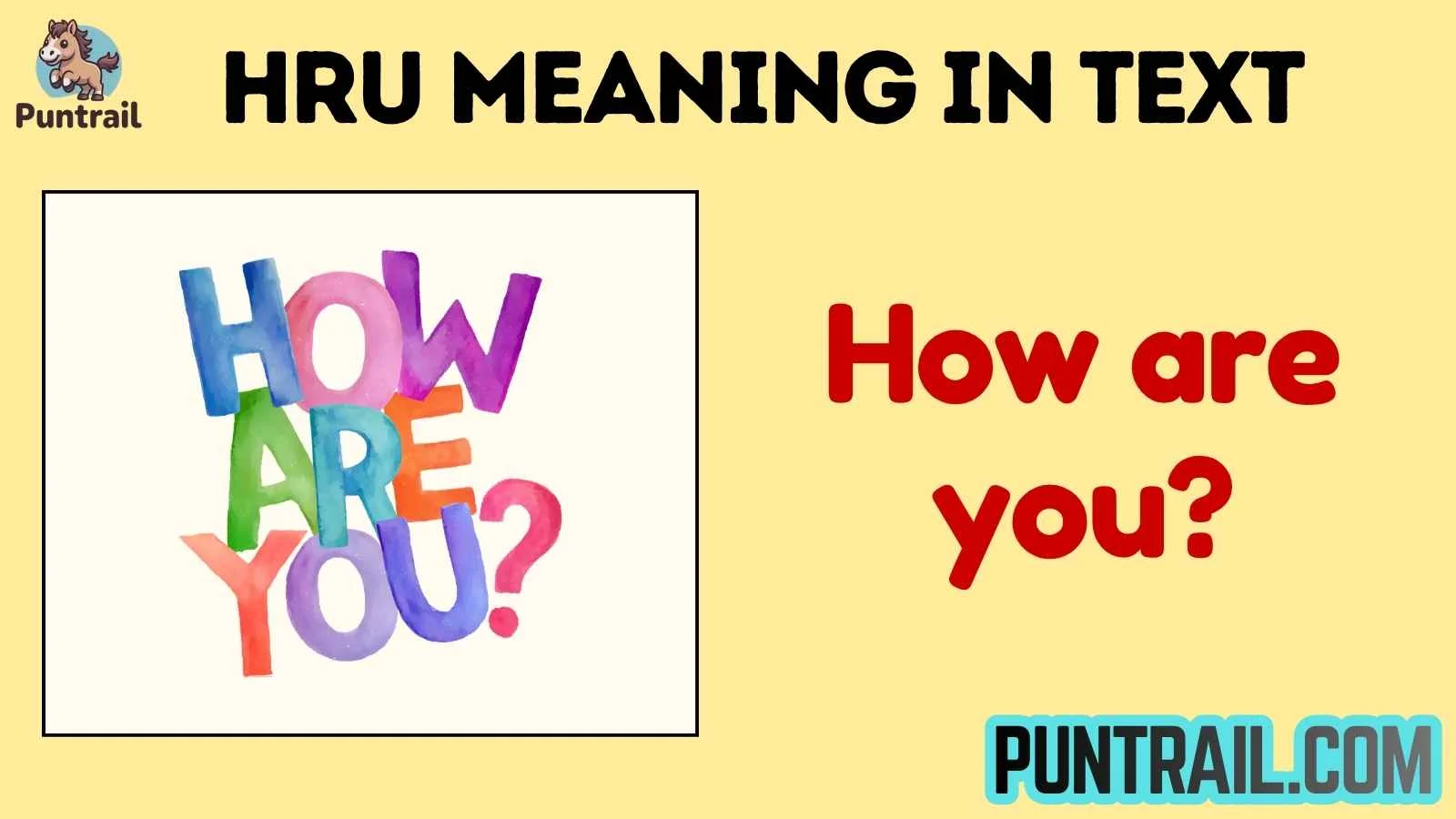
What Does HRU Mean in Text?
HRU stands for:
How Are You?
It is a common texting abbreviation used to ask someone how they are doing. Instead of typing the full question, people simply write HRU to save time while keeping the conversation friendly.
Quick Answer
| Question | Answer |
|---|---|
| Full Form | How Are You? |
| Type | Internet slang |
| Used In | Text messages, chats, social media |
| Tone | Casual and friendly |
| Purpose | To greet someone and start a conversation |
Unlike formal greetings, HRU creates a relaxed atmosphere. It works best when talking to people you already know.
Example Conversations
Example 1
Emma: HRU? 😊
James: I’m doing great! Just finished work. How about you?
Example 2
Alex: Hey! HRU today?
Sarah: Pretty good. Just relaxing at home.
Example 3
Chris: HRU?
Taylor: Busy with exams, but I’m doing okay.
These examples show that HRU is usually the first message that begins a casual conversation.
HRU Meaning in Text Explained Simply 💬
The hru meaning in text is straightforward, but the abbreviation does more than simply ask about someone’s health.
People often use HRU to:
- 😊 Start a friendly conversation
- ❤️ Show they care about someone
- 💬 Continue an existing chat
- 📱 Check in with friends
- 🤝 Build stronger relationships
- 🌟 Make conversations feel more personal
Although it literally means “How are you?”, the intention often depends on the situation.
For example:
Friend: HRU?
This could simply mean they want to chat.
Someone you haven’t heard from in months: HRU?
They may genuinely want to reconnect.
A family member: HRU?
They could be checking on your well-being.
Understanding the context helps you give the most appropriate reply.
The Origin of HRU in Online Messaging 📱
The abbreviation HRU became popular during the early days of online messaging.
Before smartphones became common, people often communicated through:
- SMS text messages
- Instant messaging platforms
- Chat rooms
- Internet forums
- Early social networking websites
Back then, many mobile phones had physical keyboards with limited texting speed. Every character mattered, especially when messages had strict character limits.
To type faster, users created abbreviations such as:
| Abbreviation | Meaning |
|---|---|
| HRU | How Are You? |
| LOL | Laughing Out Loud |
| BRB | Be Right Back |
| TTYL | Talk To You Later |
| IMO | In My Opinion |
| IDK | I Don’t Know |
| TBH | To Be Honest |
Over time, these abbreviations became part of internet culture.
Today, even though smartphones make typing easier, HRU remains popular because it is quick, familiar, and friendly.
Why People Use HRU Instead of Writing “How Are You?” 🤔
Many people ask why someone would type HRU instead of simply writing the full sentence.
The answer lies in convenience and texting culture.
1. It Saves Time
Typing three letters is much faster than typing twelve characters.
Instead of:
How are you?
People simply write:
HRU?
2. It Feels Casual
Text conversations usually sound more relaxed than emails.
Using abbreviations helps maintain that casual tone.
Example:
“Hey HRU?”
feels more conversational than
“Hello. How are you today?”
3. Everyone Understands It
Most frequent internet users recognize HRU immediately.
It has become one of the most recognizable texting abbreviations.
4. It Starts Conversations Naturally
Rather than jumping straight into a topic, people often begin with:
- HRU?
- Hey HRU
- Hi! HRU?
- HRU today?
These greetings make conversations feel polite and friendly.
5. It Fits Modern Messaging
Apps encourage quick communication.
People send dozens of short messages instead of long paragraphs.
Using abbreviations like HRU matches this communication style perfectly.
How HRU Is Used Across Different Platforms 🌍
The hru meaning in text stays the same across nearly every messaging platform. However, the style and frequency of its use may vary.
| Platform | Is HRU Common? | Typical Usage |
|---|---|---|
| SMS | ✅ Very Common | Casual greetings |
| ✅ Very Common | Daily conversations | |
| Messenger | ✅ Common | Starting chats |
| Instagram DM | ✅ Common | Friendly introductions |
| Snapchat | ✅ Very Common | Quick check-ins |
| Discord | ✅ Common | Casual chatting |
| Telegram | ✅ Common | Informal conversations |
| TikTok Messages | ✅ Common | Friendly interactions |
Regardless of the platform, the meaning remains:
“How are you?”
The tone simply depends on your relationship with the other person.
Different Ways People Write HRU ✨
Although HRU is the most common version, people often customize it depending on their personality and texting style.
Some popular variations include:
| Variation | Meaning |
|---|---|
| HRU | How Are You? |
| Hru | Same meaning |
| hru | Same meaning |
| HRU? | Asking directly |
| Hey HRU | Friendly greeting |
| Hi HRU 😊 | Warm greeting |
| HRUU | Playful version |
| Hru today? | Asking about today specifically |
Some people also add emojis to make the message feel warmer.
Examples:
😊 HRU?
❤️ HRU today?
👋 Hey! HRU?
🌞 Good morning! HRU?
These small additions can make the conversation feel more engaging and personal.
When Should You Use HRU in Text Messages? 📲
Knowing the hru meaning in text is only the beginning. Using it at the right time is just as important. While HRU is friendly and simple, it fits some conversations better than others.
Here are the most common situations where using HRU feels natural.
Catching Up With Friends
If you haven’t talked to a friend for a few days or weeks, HRU is an easy way to restart the conversation.
Example:
You: Hey! HRU? It’s been a while.
Friend: I’m doing great! How have you been?
Checking on Someone
Sometimes, you genuinely want to know how another person is feeling.
Example:
“Hi! HRU? I heard you’ve been busy lately.”
This shows care without sounding overly formal.
Starting a Casual Conversation
Many people don’t like jumping straight into a topic.
Instead, they begin with:
- HRU?
- Hey, HRU?
- Hi! HRU today?
- HRU 😊
These greetings help the conversation feel more comfortable.
Talking With Classmates
Students often use HRU before discussing homework, assignments, or exams.
Example:
“HRU? Did you finish the science project?”
Chatting With Family
Family members also use HRU to check in with one another.
For example:
“Hi Mom! HRU today?”
or
“Hey cousin, HRU?”
Reconnecting With Someone
If you haven’t spoken to someone in months, HRU is a polite way to break the silence.
Instead of immediately asking for something, you first ask how they’re doing.
That small gesture makes conversations feel more genuine.
When You Should Avoid Using HRU 🚫
Although HRU is common, it isn’t suitable for every situation.
Using it in the wrong context may appear too casual or unprofessional.
Formal Business Emails
Instead of writing:
“HRU?”
Write:
“I hope you’re doing well.”
Professional communication usually avoids internet abbreviations.
Job Interviews
When speaking with a recruiter or hiring manager, use complete sentences.
Better example:
I hope you’re having a great day.”
Academic Writing
School essays, reports, and research papers should never include abbreviations like HRU.
Always write the complete phrase:
“How are you?”
Official Customer Support
Businesses generally prefer professional greetings.
Instead of:
“HRU?”
Use:
“Hello. How may I assist you today?”
Speaking With Someone Who May Not Know Internet Slang
Older family members or people unfamiliar with texting abbreviations may not recognize HRU.
Using the full sentence prevents confusion.
How to Reply to HRU Naturally 💬
One reason people search for the hru meaning in text is because they’re unsure how to respond.
Fortunately, there isn’t just one correct answer.
Your reply depends on how you’re feeling and the type of conversation.
Friendly Replies
- I’m doing great! 😊
- Pretty good, thanks!
- Not bad. How about you?
- I’m doing well.
- Everything’s going great!
- Can’t complain.
- Life’s been good lately.
- I’m doing awesome!
Casual Replies
- Good!
- Fine 😊
- Pretty busy today.
- Just relaxing.
- Same as always.
- Doing okay.
- Hanging in there.
- All good!
Honest Replies
If you’re having a difficult day, it’s perfectly okay to be honest.
Examples:
- I’ve had a rough day, honestly.
- I’m a little stressed.
- Feeling tired today.
- Things have been challenging lately.
- I’m okay, just busy.
Being genuine often leads to more meaningful conversations.
Funny Replies 😂
Some people enjoy adding humor.
Examples include:
- Still alive. 😄
- Surviving Monday!
- Running on coffee.
- Powered by snacks today.
- Existing successfully.
- Better now that you texted!
These playful replies keep the mood light.
Real-Life Examples of HRU in Conversations 💭
Understanding conversations helps you learn when HRU sounds natural.
Example 1: Friends
Liam: HRU?
Olivia: Great! Just got home from work.
Liam: Nice! Want to play a game later?
Example 2: Family
Brother: HRU?
Sister: Doing well! Just making dinner.
Brother: Sounds delicious!
Example 3: School Friends
Emma: Hey HRU?
Sophia: Busy studying for tomorrow’s exam.
Emma: Same here! Good luck.
Example 4: Long-Time Friend
Jake: HRU? Haven’t talked in forever.
Chris: I know! I’ve been really busy lately.
Jake: We should catch up sometime.
Example 5: Social Media
Follower: HRU?
Creator: Doing amazing! Thanks for asking 😊
These conversations demonstrate how flexible HRU is in everyday communication.
Common Mistakes People Make With HRU ⚠️
Even though HRU is simple, many people use it incorrectly.
Avoid these common mistakes.
Mistake 1: Using HRU in Formal Situations
Professional communication deserves complete sentences.
Instead of:
HRU?
Write:
How are you?
Mistake 2: Ignoring the Reply
If someone answers your HRU message, continue the conversation.
Poor example:
You: HRU?
Friend: Great!
No reply.
Good example:
You: HRU?
Friend: Great!
You: That’s awesome! What have you been up to?
Mistake 3: Asking Without Caring
Don’t ask HRU if you’re going to ignore the answer.
People appreciate genuine conversations.
Mistake 4: Overusing It
Starting every conversation with HRU can become repetitive.
Sometimes try:
- Good morning!
- What’s new?
- How’s your day going?
- How have you been?
- What’s happening today?
Mixing your greetings keeps conversations fresh.
Mistake 5: Forgetting to Ask Back
If someone asks:
“HRU?”
A polite response often includes asking them the same question.
Example:
“I’m doing well! How about you?”
This keeps the conversation balanced.
HRU vs Similar Texting Abbreviations 📖
Many texting abbreviations look alike but have different meanings.
The table below highlights the differences.
| Abbreviation | Full Meaning | Main Purpose |
|---|---|---|
| HRU | How Are You? | Greeting someone |
| HYD | How You Doing? | Casual greeting |
| SUP | What’s Up? | Start a conversation |
| WYD | What Are You Doing? | Ask about current activity |
| HBU | How About You? | Return the question |
| GM | Good Morning | Morning greeting |
| GN | Good Night | Evening farewell |
| TTYL | Talk To You Later | End a conversation |
| BRB | Be Right Back | Temporary absence |
| IDK | I Don’t Know | Express uncertainty |
Although these abbreviations serve different purposes, they are often used together in text conversations.
Example:
Alex: HRU?
Taylor: Good! HBU?
Alex: Great! WYD?
Taylor: Just watching a movie.
This is a common and natural texting exchange.
HRU Meaning in Text on Social Media 📱✨
The hru meaning in text stays the same across social media platforms, but the way people use it often depends on the app and the relationship between the people chatting.
On most platforms, HRU is simply a quick, friendly way to start a conversation.
Here are a few examples of how it’s commonly used.
People often send:
- Hey! HRU? 😊
- HRU today?
- Long time no talk! HRU?
These messages are commonly used after following someone, replying to a story, or reconnecting with an old friend.
Facebook Messenger
Messenger conversations are usually a little longer, so HRU often appears as the opening message.
Example:
Ryan: Hey! HRU?
Lucas: I’m doing well! How about you?
Snapchat
Snapchat conversations are usually short and fast.
Examples include:
- HRU 😄
- Hruuu?
- HRU today?
Many users also send a selfie or Snap along with the message.
Discord
Gamers and online communities frequently use HRU before discussing games or group activities.
Example:
HRU? Ready for tonight’s match?
Friends and family often begin chats with HRU before talking about daily life.
Example:
Hi! HRU? How’s work going?
TikTok Messages
People sometimes send HRU after interacting through comments or shared videos.
For example:
Hey! HRU? Loved your latest video!
Although every platform has its own style, the goal remains the same—to begin a friendly conversation.
HRU Meaning in Different Types of Relationships ❤️
The hru meaning in text can feel slightly different depending on who sends it.
While the words stay the same, the intention may change.
Between Friends
Among friends, HRU is usually just a casual greeting.
Example:
HRU? Want to hang out later?
Between Family Members
Family members often use HRU because they genuinely want to check on one another.
Example:
HRU? Hope everything is going well.
Between Coworkers
Coworkers may use HRU in workplace chats if the company has a relaxed culture.
Example:
Morning! HRU? Ready for today’s meeting?
However, in formal workplaces, writing the full phrase is often more appropriate.
Between Romantic Partners
Couples frequently use HRU throughout the day.
Examples include:
- HRU, sweetheart? ❤️
- HRU today? Miss you.
- HRU? Hope your meeting went well.
In this context, the message often expresses care and affection.
Between New Friends
When getting to know someone, HRU is a simple conversation starter.
Example:
Hey! HRU? Nice talking with you yesterday.
Between Online Gaming Friends
Players often begin conversations with:
HRU? Ready to play?
or
HRU? Want to join the team?
It’s quick, friendly, and gets the conversation started.
HRU Etiquette: Tips for Better Conversations 🤝
Using HRU correctly isn’t difficult, but following a few simple etiquette tips can make your conversations feel more genuine.
Be Sincere
If you ask someone HRU, be prepared to listen to their answer.
People appreciate genuine interest.
Reply Within a Reasonable Time
If someone checks in on you, try to respond when you can.
Even a short reply is better than leaving the message unanswered.
Ask the Question Back
A balanced conversation feels more natural.
Example:
“I’m doing well! How about you?”
This shows that you also care about the other person’s well-being.
Match the Other Person’s Tone
If someone writes casually:
HRU? 😄
You can reply casually.
If they sound more serious:
HRU? I heard you’ve been sick.
A thoughtful response is more appropriate.
Avoid One-Word Conversations
Instead of replying:
Good.
Try:
I’m doing great! I finally finished my project today.
Adding a little detail helps the conversation continue naturally.
Similar Slang Terms You Should Know 💡
Learning the hru meaning in text often leads people to discover other popular internet abbreviations.
Here are some of the most common ones.
| Abbreviation | Meaning | Example |
|---|---|---|
| HBU | How About You? | I’m good. HBU? |
| WYD | What Are You Doing? | WYD tonight? |
| SUP | What’s Up? | Sup! |
| NM | Not Much | NM, just relaxing. |
| IMO | In My Opinion | IMO, it’s a great movie. |
| TBH | To Be Honest | TBH, I agree. |
| IKR | I Know, Right? | IKR! That’s funny. |
| IDC | I Don’t Care | IDC where we eat. |
| SMH | Shaking My Head | SMH, that’s unbelievable. |
| TTYL | Talk To You Later | Gotta go. TTYL! |
Understanding these abbreviations makes texting much easier and helps conversations flow naturally.
Is HRU Still Popular Today? 📈
Yes! Despite the constant evolution of internet slang, HRU remains one of the most widely recognized texting abbreviations.
There are several reasons why it continues to be popular.
It’s Short
Only three letters are needed to ask a complete question.
It’s Easy to Understand
Even many people who don’t regularly use internet slang recognize HRU.
It Works Everywhere
Whether you’re using SMS, WhatsApp, Instagram, Discord, Snapchat, or Messenger, HRU has the same meaning.
It Feels Friendly
Unlike formal greetings, HRU creates a relaxed atmosphere.
People often feel more comfortable responding.
It’s Timeless
Many internet abbreviations disappear after a few years.
HRU has remained popular because asking “How are you?” is something people do every day.
As long as people continue texting, HRU is likely to remain part of everyday digital communication.
Quick Summary: HRU Meaning in Text 📝
If you only remember a few things from this guide, make them these:
| Topic | Key Takeaway |
|---|---|
| Full Form | HRU = How Are You? |
| Purpose | A casual way to ask how someone is doing |
| Tone | Friendly and informal |
| Best Used With | Friends, family, classmates, and close coworkers |
| Avoid Using It In | Formal emails, business letters, academic writing, and professional interviews |
| Typical Reply | “I’m good! How about you?” |
| Common Platforms | SMS, WhatsApp, Instagram, Snapchat, Messenger, Discord, Telegram, and TikTok |
| Conversation Goal | Start or continue a friendly chat |
By understanding the hru meaning in text, you’ll be able to recognize it instantly, respond naturally, and use it confidently in your own digital conversations.
FAQs:
What does HRU mean in text?
HRU stands for “How Are You?” It is a popular texting abbreviation used to ask someone how they are doing. People commonly use it in text messages, social media chats, and instant messaging apps to start a friendly conversation.
Is HRU formal or informal?
HRU is informal. It is best used when talking with friends, family members, classmates, or people you know well. For business emails, professional conversations, or academic writing, it’s better to write the full phrase “How are you?”
How should I reply to HRU?
There are many natural ways to respond, depending on how you’re feeling. Here are a few examples:
- 😊 I’m doing great! How about you?
- 👍 Pretty good, thanks!
- 😄 Not bad! What about you?
- 💼 Busy today, but everything’s going well.
- 🌞 I’m doing well. Thanks for asking!
Adding “How about you?” helps keep the conversation going.
Is HRU still popular in texting?
Yes! Even with new slang appearing every year, HRU remains one of the most commonly used texting abbreviations. Its simplicity, friendliness, and universal meaning make it popular across messaging apps like WhatsApp, Messenger, Instagram, Snapchat, Discord, Telegram, and SMS.
Can HRU be used on social media?
Absolutely. HRU is widely used in direct messages, comments, and private chats on social media platforms. It’s a quick and friendly way to check in with someone or begin a conversation.
Common Replies to HRU 💬
If you’re unsure how to answer HRU, here are some ready-to-use responses for different situations.
| Situation | Example Reply |
|---|---|
| Happy | I’m doing great! 😊 How about you? |
| Busy | Pretty busy today, but everything’s going well. |
| Relaxing | Just relaxing at home. What about you? |
| Working | Busy with work, but I’m good! |
| Studying | Studying for exams, but doing okay. |
| Tired | A little tired today, but I’ll be fine. |
| Excited | I’m doing awesome! Can’t wait for the weekend. |
| Funny | Surviving on coffee today! ☕😄 |
These replies sound natural and encourage the other person to continue the conversation.
Key Takeaways 📌
Before you leave, here’s a quick recap of everything you’ve learned about the hru meaning in text:
- ✅ HRU stands for “How Are You?”
- ✅ It is one of the most common internet and texting abbreviations.
- ✅ It is mainly used in informal conversations.
- ✅ HRU is perfect for starting friendly chats.
- ✅ You can use it with friends, family, classmates, and close coworkers.
- ✅ Avoid using it in formal emails, business documents, or academic writing.
- ✅ A polite reply usually includes answering the question and asking “How about you?”
- ✅ HRU is commonly used across SMS, WhatsApp, Instagram, Snapchat, Discord, Telegram, Messenger, and other messaging platforms.
- ✅ Understanding common texting abbreviations makes online communication easier and more natural.
HRU Meaning in Text Cheat Sheet 📋
| Feature | Details |
|---|---|
| Abbreviation | HRU |
| Full Form | How Are You? |
| Category | Internet Slang |
| Communication Style | Informal |
| Purpose | Ask someone how they’re doing |
| Best For | Friends, family, casual chats |
| Avoid In | Professional and formal communication |
| Typical Response | I’m good! How about you? |
| Popular Platforms | SMS, WhatsApp, Instagram, Messenger, Snapchat, Discord, Telegram |
Final Thoughts:
Understanding the hru meaning in text is about more than learning a three-letter abbreviation it’s about communicating naturally in today’s digital world. HRU, short for “How Are You?”, has become a simple yet meaningful way to start conversations, check in with friends, and show genuine interest in someone’s well-being.
Although it’s informal, HRU remains one of the most widely used texting abbreviations because it’s quick, friendly, and easy to understand. Whether you’re chatting through text messages, social media, or instant messaging apps, using HRU correctly can make your conversations feel warmer and more engaging.
As online communication continues to evolve, abbreviations like HRU remind us that even the shortest messages can help strengthen relationships. By knowing when to use it, when to avoid it, and how to respond naturally, you’ll communicate with greater confidence and clarity in every chat.
Whether you’re new to texting slang or simply wanted to confirm the hru meaning in text, you now have everything you need to use this popular abbreviation the right way. Happy texting! 😊

I’m the writer behind PunTrail, where I simplify internet slang, text abbreviations, and modern word meanings into easy-to-understand content. I focus on creating clear, human-friendly explanations that help readers quickly understand trending terms used in chats, social media, and everyday conversations.